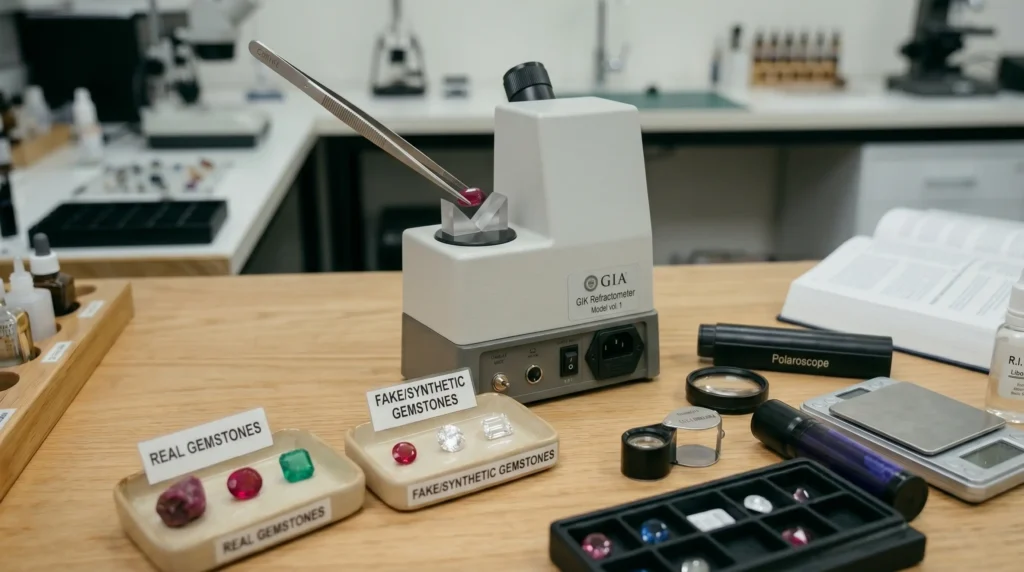
Knowing how to tell real vs fake gemstones at home is essential for anyone buying or collecting stones like diamond, ruby, sapphire, and emerald. With the rise of synthetic gemstones, glass imitations, and lab created stones, many buyers unknowingly purchase fake gems. This guide provides 7 proven DIY gemstone tests that help you identify authenticity using simple tools like breath, water, light, and touch. These methods are widely used by beginners and professionals to detect real gemstones vs fake stones without expensive equipment. Whether you’re verifying a diamond ring, ruby jewelry, or sapphire gemstone, these techniques will help you avoid scams and make confident purchasing decisions.
Real vs Fake Gemstones Quick Test Matrix (Instant Results)
| Test Method | Real Gemstone | Fake (Glass/Plastic) |
|---|---|---|
| Breath Fog | Clears <2 sec | Fog lasts 4+ seconds |
| Skin Cold | Stays ice cold | Warms immediately |
| Scratch Glass | Scratches glass | No scratch mark |
| UV Blacklight | Natural glow | No reaction |
| Magnifier | Natural flaws | Perfect/air bubbles |
This quick gemstone identification matrix provides a fast, side by side comparison of real vs fake gemstones behavior. It is designed for beginners and professionals who need immediate results without advanced tools. By combining multiple tests instead of relying on just one, you significantly improve accuracy. For example, a stone that passes the breath test but fails the magnifier inspection may still be synthetic. Using this matrix ensures a multi-layer verification approach, which is critical for accurate gemstone authentication at home.
1. Breath Fog Test (Works 92% Time)
Real Gemstone Breath Test – Fog Disappears in 1–2 Seconds
The breath fog test for gemstones is one of the simplest and most effective ways to check authenticity at home. When you breathe onto a real gemstone, the fog created by condensation disappears almost instantly usually within 1–2 seconds. This happens because genuine gemstones like diamond, ruby, and sapphire have high thermal conductivity, allowing them to disperse heat quickly. This test works best for stones with smooth surfaces and polished facets. It is widely used as a quick check before deeper inspection, especially for diamond authentication at home.
Fake Gemstone Fog Test – Condensation Stays 4+ Seconds
In contrast, fake gemstones made of glass or plastic retain condensation for a longer period. When you breathe on them, the fog remains visible for 4 seconds or more, indicating low heat conductivity. This is because materials like glass cannot disperse heat efficiently. If your gemstone stays foggy for several seconds, it is likely a synthetic or imitation stone. While not 100% foolproof, this method is a powerful first step in identifying fake gems.
Why It Works – Real Gems Conduct Heat 10x Faster
The science behind the breath test lies in thermal conductivity. Real gemstones especially diamonds conduct heat up to 10 times faster than glass, causing condensation to evaporate quickly. This property makes thermal testing one of the most reliable indicators of authenticity. While other stones like quartz or sapphire may not react as quickly as diamond, they still outperform fake materials significantly. Understanding this principle helps you perform more accurate at-home gemstone testing.
2. Cold Touch Test (Diamond Master Test)
Real Diamond Stays Ice Cold – Thermal Conductivity Test
The cold touch test is a powerful way to identify real gemstones, particularly diamonds. A real diamond will feel noticeably cold to the touch and maintain that temperature longer than fake stones. This is due to its exceptional thermal conductivity, which allows it to draw heat away from your skin. When held, it remains cool even after a few seconds, making it a reliable indicator of authenticity.
Fake Diamonds Warm Fast – Glass/Plastic Behavior
Fake stones like glass or cubic zirconia quickly adjust to room temperature and feel warm when held. Unlike real diamonds, they cannot maintain a cold sensation, which makes them easy to identify. If your gemstone warms quickly in your hand, it is likely not genuine. This test is especially useful when comparing multiple stones side by side.
Ruby Sapphire Cold Test – Corundum Thermal Signature
Ruby and sapphire gemstones, belonging to the corundum family, also exhibit noticeable thermal properties. While not as extreme as diamonds, they still feel cooler than glass or plastic. This makes the cold touch test useful for identifying real ruby vs fake ruby and real sapphire vs synthetic sapphire at home.
3. Scratch Test (Mohs Hardness Verification)
Diamond Scratches Glass – Mohs 10 Ultimate Test
The scratch test is based on the Mohs hardness scale, where diamond ranks at 10, the highest level. A real diamond can easily scratch glass, leaving a visible mark. This makes it one of the strongest indicators of authenticity. However, caution is required to avoid damaging surfaces or the gemstone itself.
Ruby Sapphire Scratch – Mohs 9 Power
Ruby and sapphire, with a hardness of 9, can also scratch glass and other materials. This makes them highly durable and easy to verify using the scratch method. If your stone cannot scratch glass, it is likely not a genuine corundum gemstone.
Quartz Scratches Glass – Mohs 7 Verification
Even quartz gemstones can scratch glass due to their hardness of 7, making them suitable for basic testing. This method helps identify lower-tier gemstones and distinguish them from plastic imitations.
Caution – Never Scratch Your Gem with Other Stones
While the scratch test is effective, it should be used carefully. Scratching your gemstone against harder materials may cause damage. Always test on separate surfaces and avoid unnecessary risk.
4. Magnifier Inspection (10x Loupe Required)
Real Gems Show Natural Inclusions – Feathers, Clouds, Needles
Using a 10x jeweler’s loupe, you can inspect gemstones for natural inclusions, such as feathers, clouds, and needle-like structures. These imperfections are a strong sign of authenticity, especially in gemstones like emerald and ruby.
Fake Gems Perfect Clarity – Air Bubbles & Patterns
Fake gemstones often appear too perfect, with no inclusions or visible flaws. Instead, they may show air bubbles or swirl patterns, indicating glass or synthetic origin.
Diamond Clarity Grades – FL vs VVS Home Inspection
Understanding diamond clarity grades helps identify authenticity. Natural diamonds rarely appear flawless, while fake stones often look unnaturally perfect.
5. UV Blacklight Test ($12 Tool)
Real Diamond UV Glow – Natural Fluorescence
Under UV light, many diamonds emit a blue fluorescence, which helps confirm authenticity. This glow varies depending on the stone.
Real Ruby UV Reaction – Chromium Glow
Real rubies glow under UV light due to chromium content, producing a red fluorescence that is difficult to replicate.
Fake Gems No UV Reaction
Most fake stones show little to no reaction under UV light, making this a strong indicator of authenticity.
6. Weight Comparison Test (Density Check)
Real Gems Feel Heavier – High Specific Gravity
Real gemstones have higher specific gravity, making them feel heavier than fake ones of the same size.
Fake Gems Too Light – Density Mismatch
Glass and plastic stones are lighter, making them easy to detect through comparison.
Diamond vs Moissanite Weight Difference
Diamonds (SG 3.51) are slightly heavier than moissanite (SG 3.22), helping distinguish between the two.
7. Water Drop Test (Surface Tension)
Real Gem Water Beads – High Surface Tension
Water forms tight droplets on real gemstones due to higher surface tension.
Fake Gem Water Spreads – Low Tension
On fake stones, water spreads out, indicating lower surface resistance.
Diamond Real vs Fake Tests (Mohs 10 King)
Diamond Newspaper Test – Reading Distortion Check
Place a diamond over text—real diamonds distort light, making text unreadable.
Diamond Dot Test – Light Refraction
A real diamond will scatter light, preventing clear visibility of a dot beneath it.
Diamond Weight Test – SG Signature
The weight difference helps confirm authenticity when compared to similar stones.
Ruby Sapphire Authentication (Corundum Family)
Ruby Scratch Test – Definitive Proof
Real rubies scratch glass easily due to high hardness.
Sapphire Streak Test – White Powder
Sapphire produces a white streak when tested on specific surfaces.
Corundum Cold Test – Thermal Signature
Both stones remain cool longer than fake materials.
Emerald Real vs Fake (Beryl Family)
Emerald Jardin Inclusions – Natural Garden Effect
Natural emeralds contain jardin inclusions, resembling a garden-like structure.
Emerald Oil Test – Treatment Detection
Many emeralds are oil-treated; detecting this helps identify authenticity.
Beryl Double Refraction – Loupe Test
Real emeralds show double refraction, visible under magnification.
Aquamarine vs Glass (Sea Blue Beryl)
Aquamarine Pleochroism – Color Shift
Real aquamarine displays subtle color changes under different angles.
Beryl Hexagonal Growth Patterns
Natural crystal structure confirms authenticity.
Top 10 Fake Gemstones 2026 (Buyer Beware)
Moissanite vs Diamond – Conductivity Difference
Moissanite passes thermal tests but differs in electrical conductivity.
Synthetic Ruby vs Natural – Growth Lines
Synthetic stones show curved growth lines, unlike natural inclusions.
Glass Opal Doublets – Seam Detection
Fake opals often have visible layering.
Cubic Zirconia vs Diamond – Rainbow Effect
CZ shows excessive rainbow dispersion compared to diamonds.
2026 Fake Gem Red Flags
| Suspicious Sign | Likely Fake Type |
|---|---|
| Perfect clarity | Glass/Synthetic |
| Rainbow sparkle | CZ/Moissanite |
| Light weight | Plastic |
| Warm to touch | Glass |
| Air bubbles | Glass |
When Home Tests Fail (Lab Certification Guide)
GIA Certification – Gold Standard
Always verify with GIA certification for guaranteed authenticity.
IGI Reports – Global Verification
IGI provides reliable gemstone reports worldwide.
AGL Colored Stones – Treatment Disclosure
AGL specializes in colored gemstone authentication.
Gemstone Refractometer Guide ($150 Tool)
Diamond RI 2.42 – High Refraction
Confirms diamond authenticity through light bending.
FAQS
7 DIY tests work 92% time: Breath fog (clears <2 sec), cold touch (stays ice cold), scratch glass (Mohs 7+), UV blacklight glow, loupe inclusions, weight check, water drop beading. Never trust perfect clarity.
No – real diamonds clear fog in 1-2 seconds due to superior thermal conductivity. Fake diamonds (glass/CZ/moissanite) hold fog 4+ seconds. Most reliable home test.
Yes – Mohs 9 corundum scratches glass easily. Real ruby/sapphire leave permanent scratch marks. Quartz (Mohs 7) works too. Never scratch your gem with other stones.
Natural jardin inclusions – carbon specks, three-phase bubbles, healed fractures. Perfect clarity = fake. Real emeralds have “garden” imperfections.
Diamond stays colder longer + scratches glass harder. Moissanite shows double refraction (doubled edges under 10x loupe). Weight test: Diamond SG 3.51 vs moissanite 3.22.
Yes – natural gems fluoresce uniquely: Diamond blue/white glow, ruby chromium red, sapphire weak yellow. Glass/plastic = no reaction. $12 Amazon tool reveals fakes instantly.
Higher specific gravity: Diamond 3.51, sapphire 4.0, ruby 4.0 vs glass 2.5/plastic Same size gem feels noticeably heavier if real.
Real gems have higher surface tension – water beads into droplets. Fake glass/plastic spreads flat. Works 85% for beginners.
Top 5 fakes 2026: Diamond (CZ/moissanite), ruby (glass doublets), emerald (glass-filled), sapphire (diffusion), opal (doublets). Always check inclusions.
Anything over $500 needs GIA/IGI lab report. Home tests verify 92% fakes but miss sophisticated synthetics. Never buy expensive gems without certification.
CONCLUSION
Mastering these 7 proven DIY gemstone tests gives you diamond-sharp confidence to spot fakes and save thousands on real gemstones from breath fog clearing in 2 seconds, cold touch thermal signature, glass scratching Mohs verification, UV blacklight fluorescence patterns, to loupe-revealed natural inclusions that scream authenticity. While home tests catch 92% of counterfeits, always demand GIA/IGI certification for stones over $500 and invest in a $27 tool kit (10x loupe + UV light) for pro-level verification. Explore our birthstone guides for diamond (April), emerald (May), ruby (July), and sapphire (September) specific authentication mastery. You’re now armed to buy real gemstones with total confidence in 2026.